
Do Kettles Release Microplastics?
Water Touches Only Steel.
Plastic often hides in the lid, the strainer, the seal. We took it out of all three. Stainless steel water path, independently lab-tested.


Heat Breaks Plastic Down
Plastic softens well below boiling point. Each heating cycle loosens the surface a little more, releasing microplastics straight into your cup.
Built from Steel
Plastic hides in small places. The seal, the strainer, inside the lid, the sensor. We went through them one by one, replacing each with steel.
Tested by an Outside Lab
No plastic in the water path means nothing to break down. An independent lab checked for BPA, phthalates, PFAS and heavy metals. All below measurable levels. Full report below.
 Go Plastic-Free
 Written byDr. Omer Deveci, MD·Founder, Saki ProductsUpdated August 26, 2026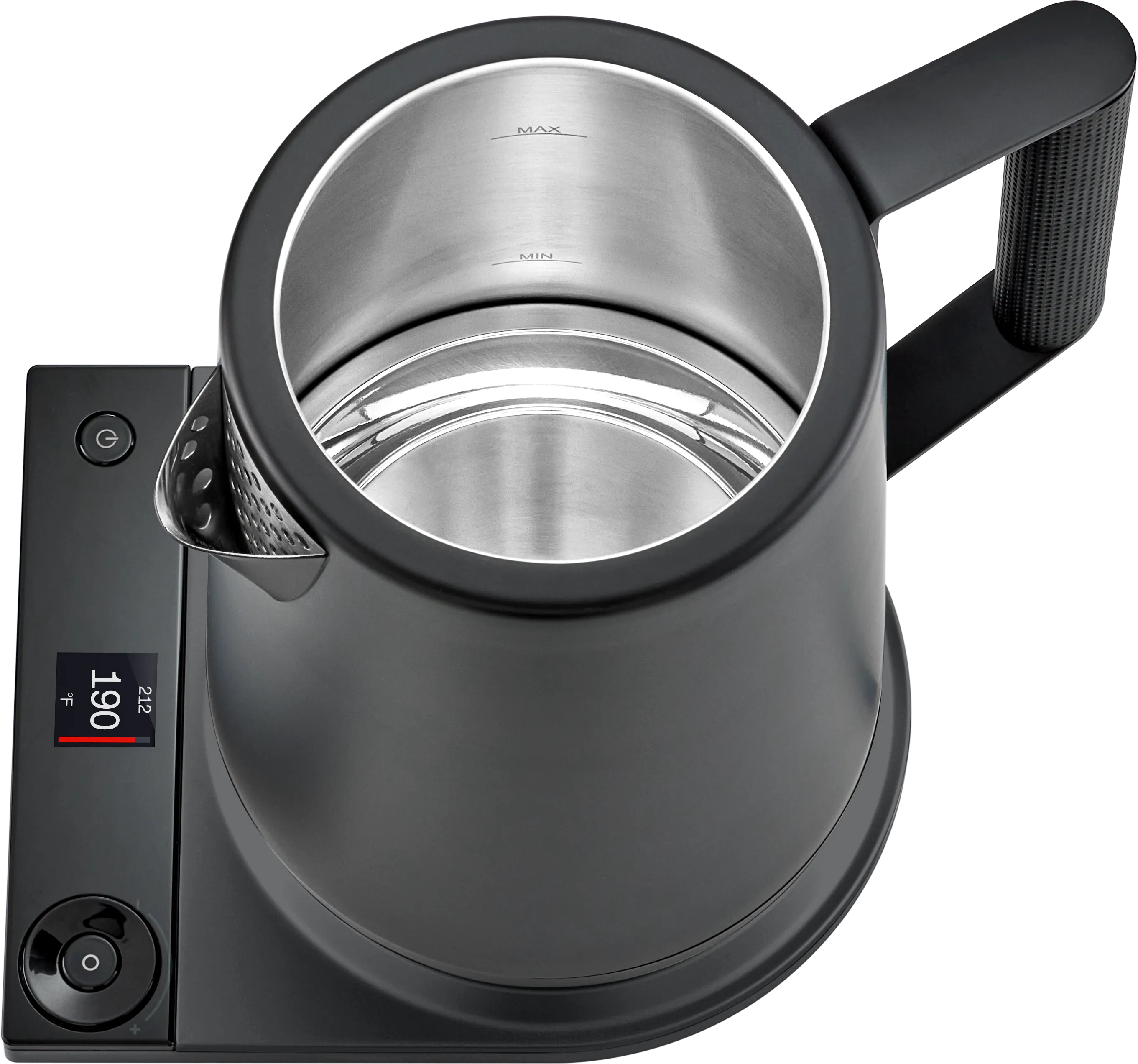
The Water Path.
100% Plastic-Free.
Water goes in, sits against these walls while it heats, passes the sensor, and leaves through the spout. That is the whole path. Every surface along it is steel.
The base is welded to the body. Most kettles crimp it and fit a rubber ring at the joint, which sits in the water. Ours has no ring there.
Look at the fill lines. They are stamped into the metal, not printed on and not set behind a plastic window.
Why Plastic-Free
Matters
The simplest way to cut microplastic exposure from your kettle is to take plastic out of the water path. Microplastics have been found in human blood and lung tissue. Kettles made with plastic have been shown to release particles while boiling.
(Leslie et al. 2022 · Jenner et al. 2022 · Shi et al. 2025)
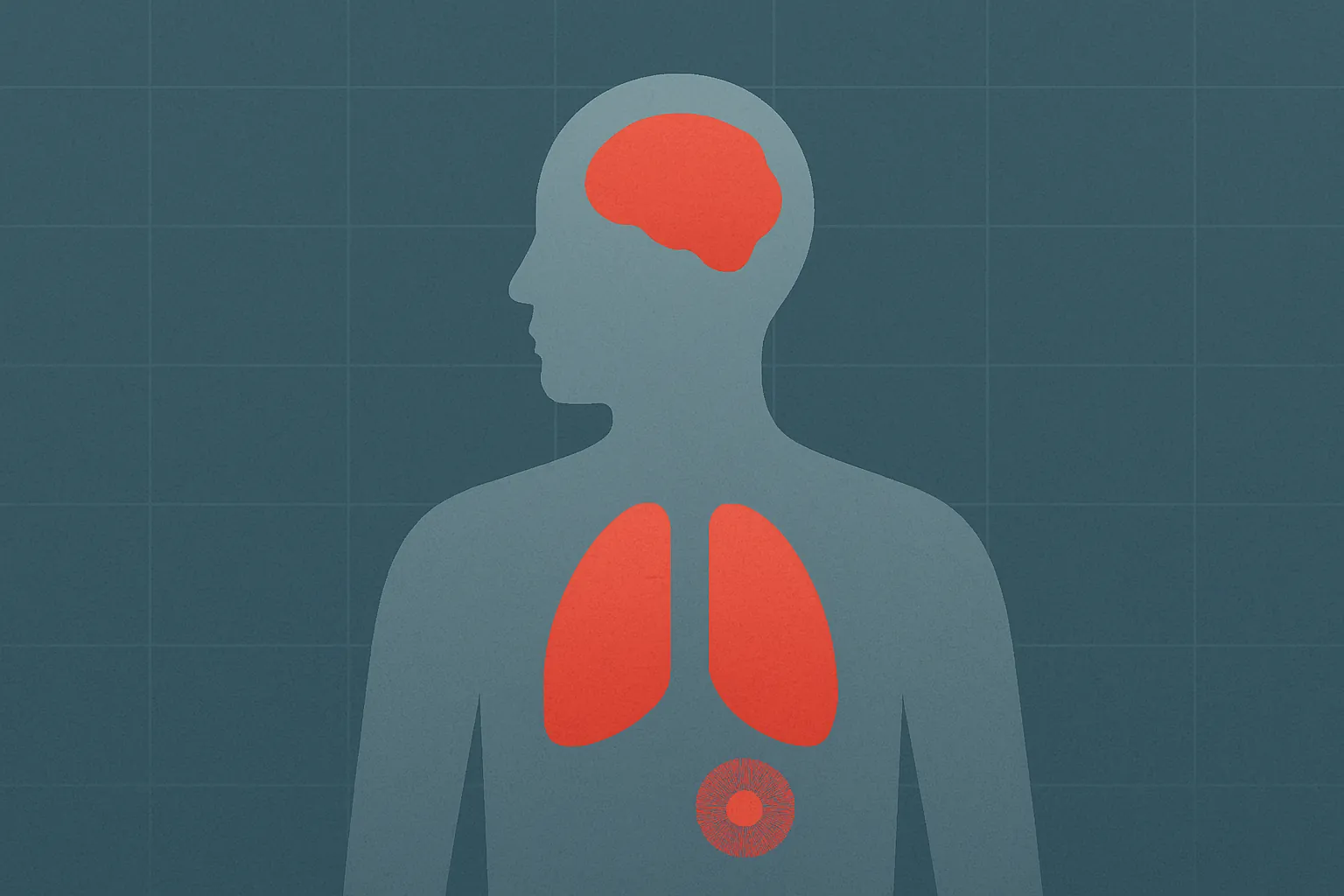
They're Already in Us
Microplastics have been detected in blood, lung tissue and other organs. What this means for health is still being studied, but we know the exposure is real.
These particles come from things we use every day. One of them is the kettle.
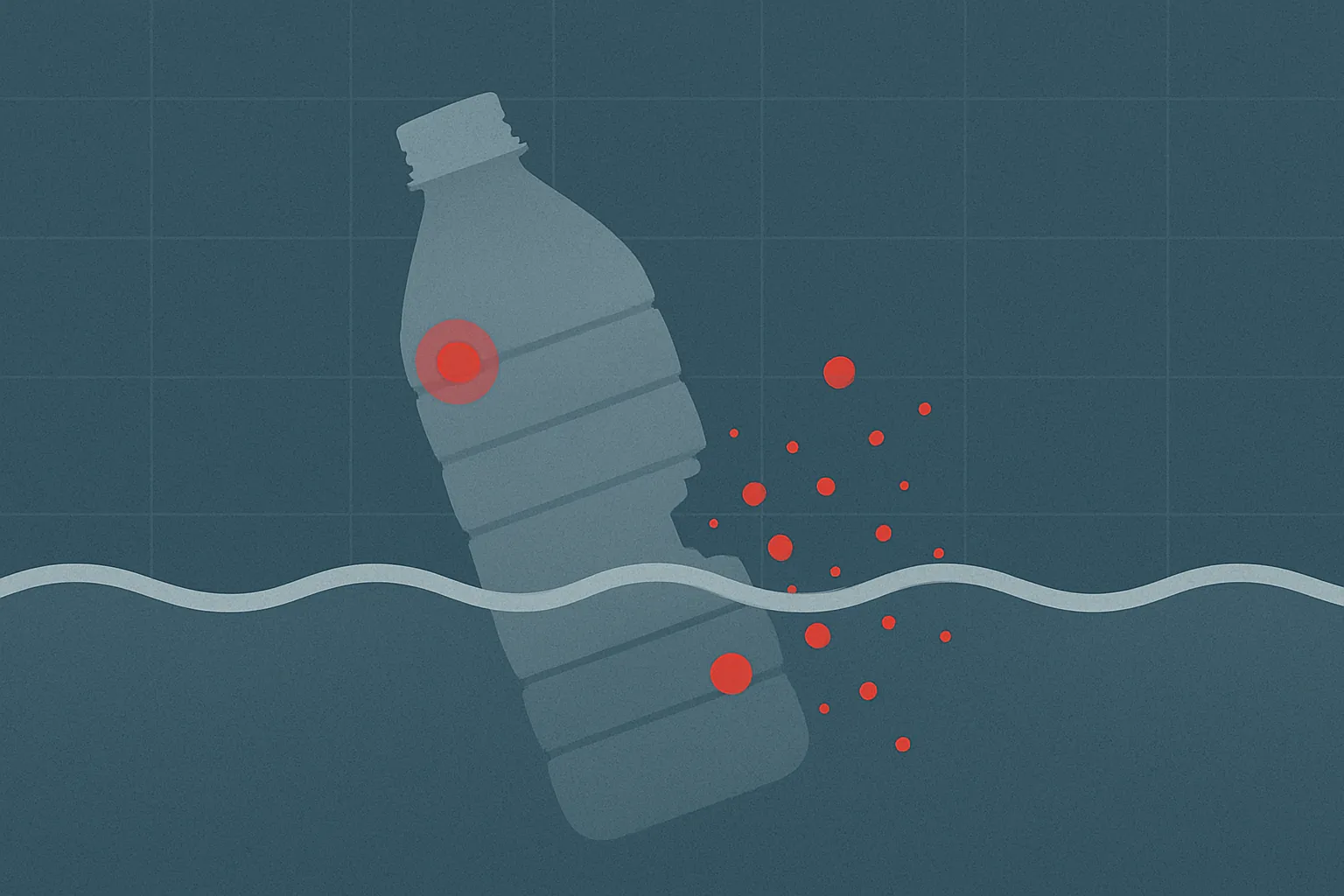
Where They Come From
Heat weakens plastic, and weakened plastic releases microscopic particles into the water. Boiling speeds this up.
The surface loosens with each cycle of heating and cooling. A kettle that has boiled a thousand times is rougher than the day it was bought.
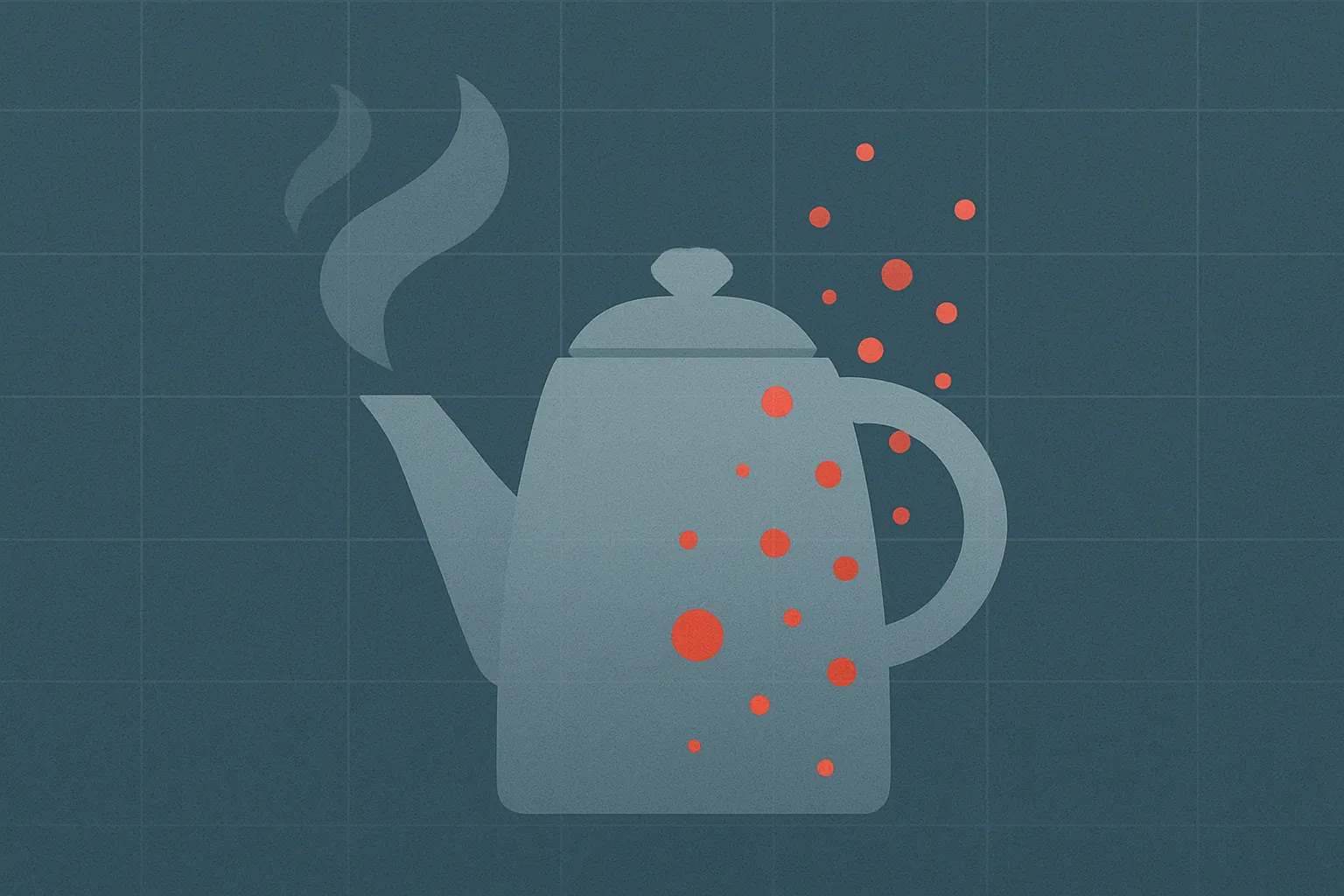
When They Shed Most
A new plastic kettle sheds hardest in its first uses. This is the burst release phase, when heat works fastest on a surface that has never been heated.
It slows down after that, but it does not stop. Every boil after the first still takes something off.

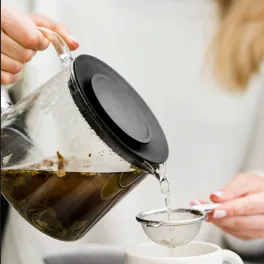
What Touches Water, Touches You
We went through the kettle part by part and asked one question about each. Does the water reach it? If the answer was yes, plastic was off the table.
The Interior
Food-grade 304 steel all the way down. Most kettles put a clear window on the side so you can see the level, and that window is plastic sitting in the water. We stamped the marks into the steel instead.
The Lid and Seal
The underside of the lid is steel. That side matters more, because steam collects there and drips back down into what you are about to drink. It is also the part people rarely check.
The Spout and Sensor
The strainer holes are cut into the steel itself, so there is no insert to clip in and yellow with age. The temperature sensor is steel too, down to the part that sits in the water.
Tested. Verified.
Trusted.
We’ve partnered with Light Labs to verify that in the tested Luna Kettle, a sample Saki product, BPA, phthalates, PFAS, and heavy metals were not detected — substances that can potentially leach into your water from plastics, coatings, or other material sources. Because when it comes to what you drink, purity should be tested, not trusted.
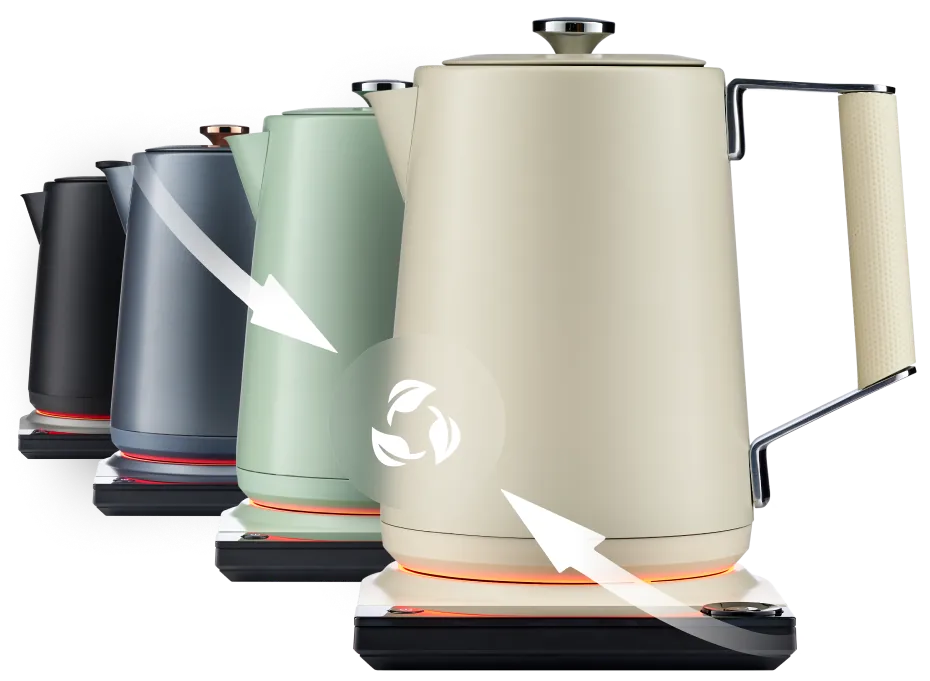
Keep Plastic Out of Your Water
Did you know that your boiling water comes into contact with plastic surfaces when preparing your hot drinks? Enjoy the taste of healthy and pure water in your kitchen with the Saki Luna, a true plastic-free kettle! Thanks to its 100% stainless steel interior design, your water never touches plastic at any stage.
Powerful Heat,
Perfect Brew


Independent Lab Results
Saki Luna Kettle (Black) — Light Labs Certificate of Analysis, Order 3025
The Saki Luna Kettle was tested by Light Labs (Ann Arbor, MI — ISO/IEC 17025 accredited) for heavy metals, bisphenols (BPA/BPS/BPF), phthalates, and PFAS. Across all four panels, every analyte returned "Not Detected." Order 3025 · Sample received Nov 4, 2025 · Tested Nov 2025.
| Panel | Analytes tested | Method | Result |
|---|---|---|---|
| Heavy metals | Arsenic, Cadmium, Lead, Mercury | ICP-MS/MS (LLMTDA, mod. FDA EAM 4.7) | ✓ ND |
| Bisphenols | BPA, BPS, BPF and analogues | LC-MS/MS | ✓ ND |
| Phthalates | 16 compounds incl. DEHP, DBP, BBP | GC-MS/MS | ✓ ND* |
| PFAS | 30 compounds incl. PFOA, PFOS, PFBS | LC-MS/MS (FDA CAM C-010.02 mod.) | ✓ ND |
"Not Detected" (ND) means no measurable amount was found above the method's limit of quantitation. *Two phthalates (dimethyl, diethyl) appeared in trace amounts below the 1 ppb quantitation limit. Results relate only to the product tested.
About the Author
Dr. Omer Deveci
Founder & CEOSaki Products · Newport Beach, California
Medical doctor and serial entrepreneur. In Turkey, he founded Şikayetvar, the country's leading consumer feedback platform, connecting millions of voices with brands and making trust measurable. He brought that same philosophy to Newport Beach, California, where he founded Saki: transparent materials, independent laboratory testing, provable trust.
View on LinkedInFrequently Asked Questions
About microplastics and plastic in hot water
Yes. Plastic kettles shed micro- and nanoplastic particles into water during boiling, and the release is highest when the kettle is new. University of Queensland research (2025) found a new kettle's first boil released roughly 12 million nanoparticles per milliliter — and particles were still detectable even after 150 uses. Heat accelerates this shedding, which is why a boiling kettle is a meaningful exposure source.
Source: Shi, Okoffo et al., npj Emerging Contaminants (2025)
Not necessarily. Many kettles marketed as "stainless steel" still contain plastic in the parts that touch water — water-level gauges, lids, seals, filters, and interior linings. The label describes the body, not the full water path. That's why we built every water-contacting surface of the Luna Kettle from 304 stainless steel, with no plastic contact point.
No. "BPA-free" only means one specific chemical (bisphenol A) is absent — the plastic itself is still there and can still release micro- and nanoplastic particles when heated. Avoiding microplastic exposure requires removing plastic from the water path entirely, not replacing one plastic with another.
It depends on the container. Boiling in a plastic kettle adds particles shed by the plastic, but boiling itself can reduce microplastics already present in tap water. A 2024 study found that boiling and filtering calcium-rich tap water removed up to about 90% of nano- and microplastics. Boiling in a plastic-free kettle gives you that benefit without turning the kettle into a new source of plastic.
Source: Yu et al., Environmental Science & Technology Letters (2024)
The long-term health effects are still being studied, but microplastics have now been detected inside the human body — in blood, lung tissue, and brain tissue. Laboratory studies suggest particles of this size can trigger inflammation. Because the risks aren't yet fully understood, many people choose to limit avoidable exposure where they reasonably can.
Source: Leslie et al. (2022); Jenner et al. (2022); Nihart et al. (2025)
Focus on the sources you can control. Three evidence-based steps: boil and filter hard tap water (removes up to ~90% of particles), reduce single-use plastic bottles (93% of bottled water samples contained microplastics), and remove plastic from anything heated with your water — starting with your kettle.
Source: Yu et al. (2024); Mason et al. (2018)
Yes. Researchers describe the first uses of a plastic kettle as a "burst release phase," when heat and friction trigger the highest particle release. University of Queensland measurements (2025) showed the highest levels in the first few boils, declining over time but never reaching zero. A plastic-free kettle avoids this entirely.
Source: Shi, Okoffo et al., npj Emerging Contaminants (2025)
The water path is every surface your water touches from filling to pouring: the interior wall, the heating base, the lid underside, the spout, the strainer, the fill marks and any seal or gasket in between. Many kettles hide plastic in these components even when the outer body is metal. We engineered the entire Luna water path from 304 stainless steel, with no plastic contact point, because purity only counts where the water actually goes.
The Saki Luna Kettle was tested by Light Labs, an independent ISO/IEC 17025 accredited laboratory in Ann Arbor, Michigan, for bisphenols (BPA, BPS, BPF), phthalates (16 compounds), PFAS (30 compounds) and heavy metals (arsenic, cadmium, lead, mercury). Every analyte returned Not Detected. The full Certificate of Analysis is published on this page and on the Luna product page, so you can read the results yourself rather than take our word for it.
References
Last updated: August 26, 2026- Microplastics in blood: Leslie, H. A., et al. (2022). Discovery and quantification of plastic particle pollution in human blood. Environment International, 163, 107199.doi:10.1016/j.envint.2022.107199 ↗
- Microplastics in lungs: Jenner, L. C., et al. (2022). Detection of microplastics in human lung tissue using µFTIR spectroscopy. Science of the Total Environment, 831, 154907.doi:10.1016/j.scitotenv.2022.154907 ↗
- Microplastics in brain: Nihart, A. J., et al. (2025). Bioaccumulation of microplastics in decedent human brains. Nature Medicine, 31, 1114–1119.⚠ New & debated findingdoi:10.1038/s41591-024-03453-1 ↗
- Kettle particle release: Shi, K., Okoffo, E. D., et al. (2025). Release of nanoplastics from polypropylene kettles. npj Emerging Contaminants.doi:10.1038/s44454-025-00018-w ↗
- Microplastics in bottled water (93%): Mason, S. A., Welch, V. G., & Neratko, J. (2018). Synthetic polymer contamination in bottled water. Frontiers in Chemistry, 6, 407.doi:10.3389/fchem.2018.00407 ↗
- Microplastics in tap water (83%): Kosuth, M., Mason, S. A., & Wattenberg, E. V. (2018). Anthropogenic contamination of tap water, beer, and sea salt. PLOS ONE, 13(4), e0194970.doi:10.1371/journal.pone.0194970 ↗
- Weekly plastic intake (up to 5g): WWF / University of Newcastle (2019). No Plastic in Nature: Assessing Plastic Ingestion from Nature to People.⚠ Upper bound estimatewwf.panda.org ↗
- Microplastic reduction by boiling: Yu, Z., Wang, J., Liu, L., Li, Z., & Zeng, E. Y. (2024). Drinking boiled tap water reduces human intake of nanoplastics and microplastics. Environmental Science & Technology Letters, 11(3).⚠ Not specific to plastic-free kettlesdoi:10.1021/acs.estlett.4c00081 ↗
- Saki Lab Tests: Light Labs — Independent lab verification for BPA/BPS/BPF (bisphenols), phthalates (16 compounds), PFAS (30 compounds), and heavy metals. Every analyte returned Not Detected. The microplastic-free claim is based on the plastic-free water path design — no plastic in the water path. Order 3025, tested Nov 2025.